
Real estate agents vs. Opendoor
listing leads · cash offer ads
The 2025 numbers, and why your cash offer ads should stop sounding like Opendoor's
Agents writing cash offer ads should start with the 2025 ratio: roughly 450 US homeowners sold with an agent for every one who sold to Opendoor, or 8,241 sellers out of 4.06 million existing-home sales, which is 0.20% of the market. Cash offer ads are still worth running: a homeowner searching for a cash offer is among the highest-intent sellers you can reach. The problem is that nearly every agent writes those ads in Opendoor's vocabulary: fast, easy, no repairs, no showings. Those are all what I call feature-positive claims, meaning copy that sells what your option gives the seller, and they make speed the decision criteria and hand the argument to the cash buyer. Feature negative framing, my label for the opposite move, sells what the other option costs the seller; neither phrase is established industry vocabulary. Opendoor spent about $555 million on that vocabulary. This article covers what the seller data shows, why the entire category speaks one language at the ad level, and how to run the same ads with feature negative framing so the cash offer becomes the expensive option.
What ChatGPT recommends when a seller asks it to choose
The case for rewriting your cash offer ad copy starts with a fact already in your favor, so I typed one sentence into ChatGPT:
"Should I list my home with an agent or sell it to Opendoor?"
No context. No zip code. No urgency framing. This is the question a homeowner asks at 11pm, two weeks out from deciding what to do with the largest asset they own, and increasingly it is the question they ask before they ever contact an agent.
I wanted to see what the model said when nobody was steering it.
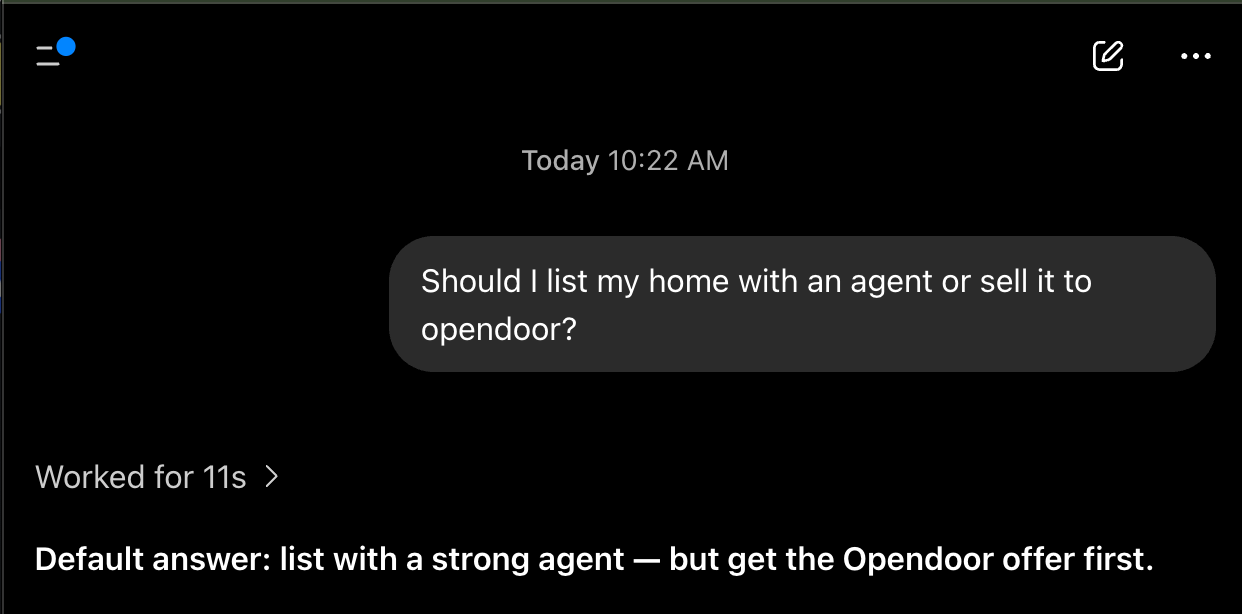
ChatGPT's answer, no context given. The default is the finding.
It does not refuse the question, and it does not hedge. It picks a side.
The default is the finding. The model is not giving an opinion. It is repeating what everything written on the subject already treats as normal. It is telling the seller what the market already believes.
For an agent, that means one thing: the seller shows up already leaning your way. You have the lead before you spend a dollar. How you spend it decides whether you keep it.
How many US sellers chose Opendoor in 2025
The market data says the same thing ChatGPT said.
4.06 million existing homes sold in the United States in 2025 (NAR, reported January 14 2026). Sales remain stuck near a 30-year low.
8,241 of those sellers sold their home to Opendoor. That figure is homes Opendoor purchased from a homeowner, taken from Opendoor's FY 2025 earnings release, published February 19 2026. It is not the resale figure. Opendoor resold 11,791 houses in 2025, and those resales mostly hit the MLS and already sit inside the 4.06 million. The number that describes consumer choice is 8,241.
8,241 out of 4.06 million is 0.20% of the market. One seller in 493.
On the agent side: NAR's 2025 Profile of Home Buyers and Sellers found 91% of sellers used an agent, a record high, with FSBO at 5%, a record low. Applying 91% to 4.06 million gives roughly 3.69 million agent-assisted sellers.
the ratio, 2025
450 : 1
About 450 sellers with an agent for every one seller who sold to Opendoor.
1,000 dots. Each dot represents roughly 4,000 sellers. Find the orange ones.
This is not a competitor's spin on Opendoor's performance. Opendoor's own 2025 Form 10-K states that nearly 90% of US transactions still involve an agent, and that digital cash buyers captured less than 1% of the $1.7 trillion in volume. That filing is public on SEC EDGAR under Opendoor Technologies Inc., CIK 0001801169.
What Opendoor's $555 million in advertising actually bought
The easy story is that Opendoor's model does not work. That story is wrong, and Opendoor's last two quarters are the reason.
First, the spend. Opendoor went public December 18 2020. Every figure below is the advertising line from the 10-K, not the much larger "sales, marketing and operations" line. SM&O was $1.006 billion in 2022 and $310 million in 2025, and consists mostly of property taxes, utilities, holding costs, resale broker commissions and headcount. Advertising is the small slice inside it.
year advertising spend 2020$33.1M 2021$123M 2022$200M (peak) 2023$75M 2024$86M 2025~$47M H1 2026$24M ($19M Q1, $5M Q2)
Sources: 2020 10-K footnote, 2021-2023 footnote, 2022-2024 footnote, Q2 2026 release. Total 2021 through 2025: about $531 million. Add the first half of 2026 and the figure is roughly $555 million.
Now the comparison that matters.
q2 2022
$13,500
per contract. $81 million in one quarter to clear just over 6,000 acquisition contracts.
q2 2026
$724
per contract. $5 million and 6,908 contracts signed, or $1,142 per home actually purchased (4,378 purchases).
Same volume. Sixteen times less advertising money.
Q2 2026 is not an isolated quarter. In Q1 2026 Opendoor spent $19 million and signed 5,136 contracts. In Q2 the company spent $5 million and signed 6,908. Spend fell; volume rose.
Two operating figures carry the ad-copy argument, because they show the cost collapse came from operations rather than advertising: ops cost per close fell from $8,400 a year ago to $3,000 in Q2 2026, and contribution margin reached 5.8% against a 1% bottom three years ago. The remaining metrics are context only:
- Ops cost per close: $8,400 a year ago → $5,000 in Q1 2026 → $3,000 in Q2 2026
- Contribution margin: 5.8%, against a bottom of 1% three years ago
- Aged inventory over 120 days: 51% in September 2025 → 9% now, versus 27% for the broader market
- Homes under contract to buy: 2,310, versus 393 a year earlier
- Signing pace: 500+ contracts a week, with one week above 700
On Opendoor's August 4 2026 earnings call, chief executive Kaz Nejatian put marketing at 0.3% of acquisition GMV, down from 1.6% under the prior model. Opendoor is guiding to 0.5% on the expectation that 0.3% does not hold. Combined marketing and operations cost per contract is the lowest since Opendoor began tracking the metric in 2018.
So here is the honest read, and it is more useful than "the model failed."
Opendoor's $555 million in advertising bought 0.20% of the market. Opendoor's product changes bought a 16x cost collapse and a rising volume line. Those are two different levers, and advertising is the expensive one.
Hundreds of millions in ads did not change how Americans sell a house. Ads cannot do that. A habit is not a preference you can outbid. This one was set long before Opendoor showed up, and a Facebook ad does not get to argue with it. The seller is not thinking I would like a shorter time to close. The seller is thinking I'm selling my house, and the way you sell a house is you call an agent.
A default is not a preference you can outbid.
What finally moved Opendoor's numbers was placement, not persuasion. Cash Now More Later. The RealScout offer sitting inside the listing flow. A mortgage product set as the default on Opendoor's own resales. None of those three, Cash Now More Later, the RealScout in-flow offer and the default mortgage product on Opendoor's resales, argue with a homeowner. Each one shows up in a step the homeowner is already taking, after the address is typed, when the seller is already looking.
Opendoor's product replaced Opendoor's $81 million quarter. The company stopped buying the category and started owning the moment.
Run the ads. Change the argument inside them.
Cash offer ads work, and agents should keep running them.
Walking away from that intent because Opendoor wants it too would be a mistake; for the campaign mechanics behind these ads, see our guide to home seller leads and the real estate digital advertising playbook.
The problem is not the channel. The problem is that almost every agent running these ads writes them in Opendoor's vocabulary.
Go look at the source material. It is all public:
- Meta Ad Library: search "Opendoor," filter to your region. Every active ad, every variant, the date each started running.
- Google Ads Transparency Center: search the advertiser, see the served creative.
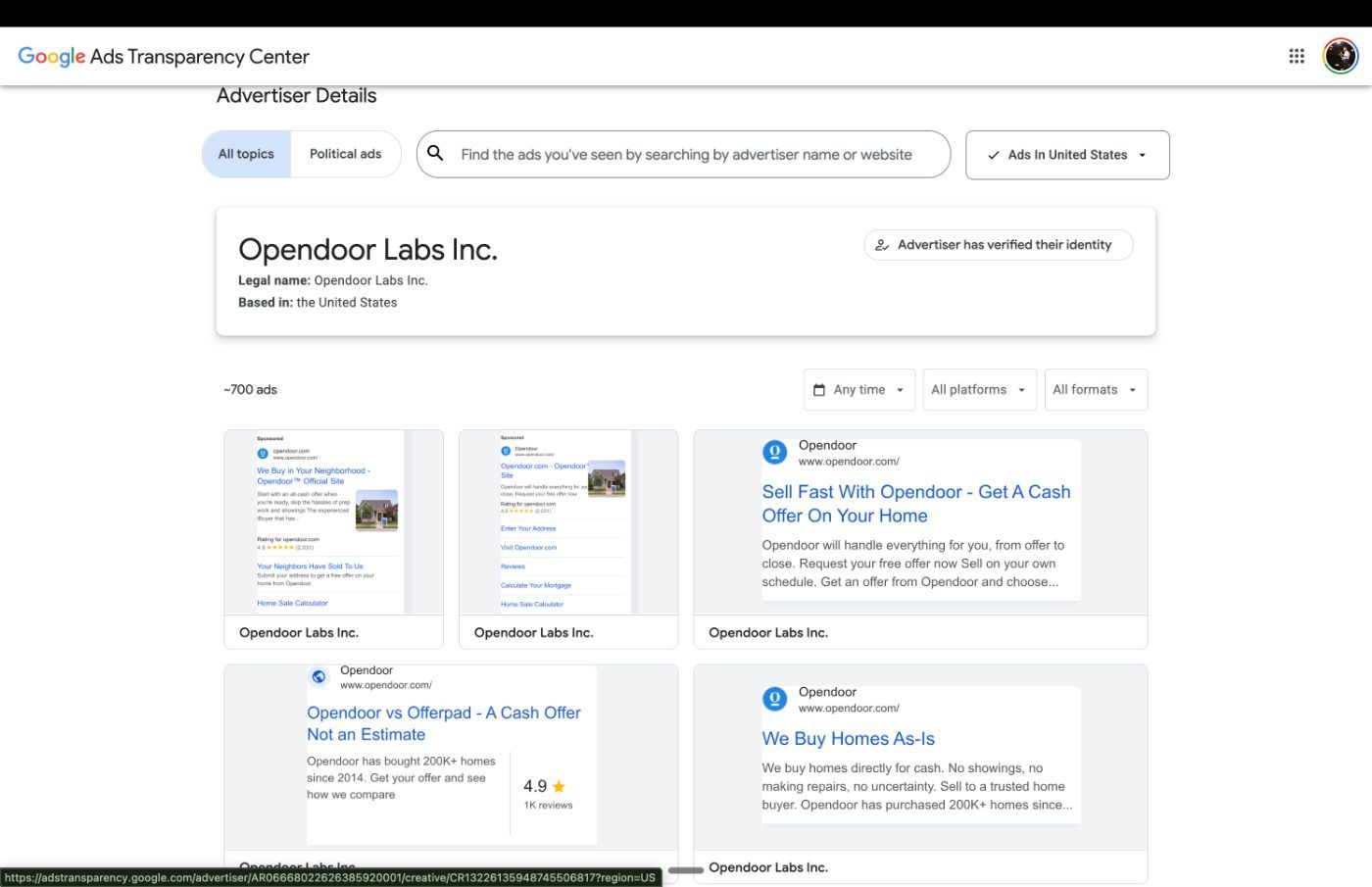
Google Ads Transparency Center: Opendoor Labs Inc., roughly 700 active ads. Every headline is speed or convenience.
Every one of those ads is feature-positive: sell in days, skip the showings, pick your close date, no repairs, no strangers walking through your kitchen. Clean, professional, expensive. And every promise in the ad is speed or convenience, so the ad is teaching the seller that speed and convenience are how to decide.
Now open the ad library for the agents in your market running cash offer creative. You will find the same sentences. Fast, easy, no repairs, no showings, offer in 24 hours.
An agent running feature-positive cash offer copy is spending money to make Opendoor's argument. The ad qualifies a motivated seller and then hands them a set of criteria an agent cannot win on. A listing period is never going to beat a seven-day close. The lead was good. The frame was borrowed from the competition.
Here is what makes this fixable rather than fatal: the entire category speaks one language. Opendoor's $555 million in advertising was feature-positive. So is the creative from every iBuyer, every cash-offer aggregator, and nearly every agent imitating them. Nobody is running the opposite argument at the ad level.
That means the negative frame is uncontested in the exact channel where the intent already exists. Same audience. Same search. Same address-capture mechanic. Different argument.
You do not need a new lead source. You need different copy in the one you already have.
Feature negative framing: the same ad, the opposite argument
Feature-positive framing says: here is what my option gives you.
Feature negative framing says: here is what their option costs you.
This works better against a habit, and the reason is well documented: loss aversion, from Daniel Kahneman and Amos Tversky's prospect theory work (Econometrica, 1979) and later estimated at a roughly 2:1 ratio, means a dollar lost hurts about twice as much as a dollar gained feels good. Selling on what the seller gains fights the habit with the weaker argument. Selling on what the seller is losing right now uses the stronger one.
Applied to a cash offer, the move is not "an agent gets you a better price." That is positive framing, and it evaporates on contact with yeah, but it takes three months.
The move is to reposition the convenient option as the expensive option, and to make the cost specific.
four steps
- Name the number the seller cannot see. Not "you might get less." A real figure on their actual house: service fee plus the spread between the cash offer and likely market price. A vague cost does not sting. A specific one does.
- Turn that number into something the seller was already going to buy. Not "$34,000." Instead: "$34,000. That's the down payment on the next house." Abstract money does not hurt. Money attached to a thing someone wanted hurts.
- Concede the speed immediately and completely. Do not argue that the fast option is not fast, because it is fast and the seller knows it. Concede it, then price it: "They'll close in seven days. That's real. Here's what those seven days cost." Skipping this step is the most common mistake, and it costs you the trust the rest of the argument needs.
- Let the seller do the arithmetic out loud. Deliver the math and stop talking. A conclusion someone reaches themselves is a conclusion they defend.
What the seller ends up believing: this is not a choice between two ways to sell a house. It is a decision about how much to pay for speed, and nobody has shown them the price.
That is the reframe Opendoor never applied to itself.
Feature negative framing examples
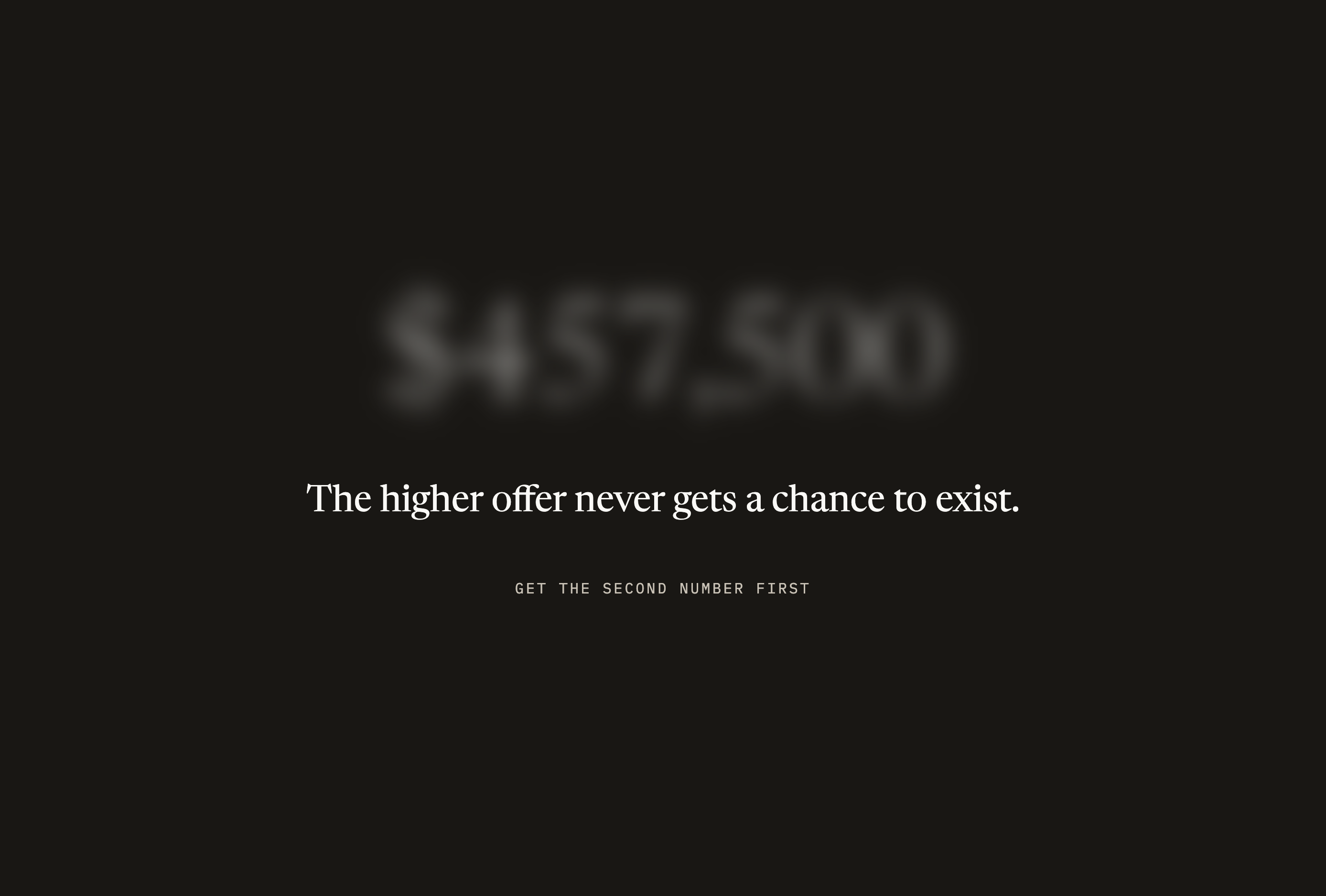
Mail front. The number the seller cannot see, withheld.
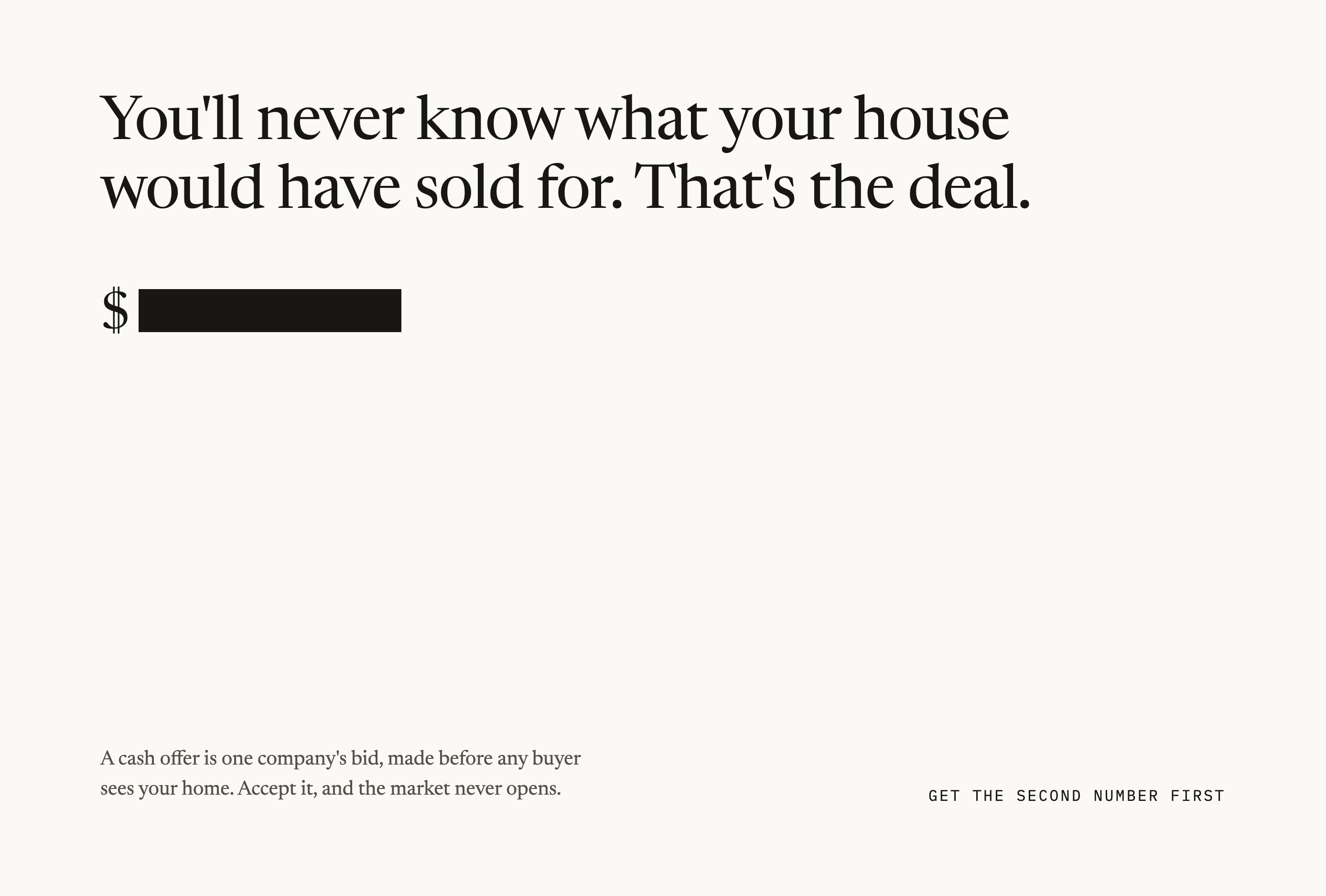
Mail front. The redacted deal: accept the offer and the market never opens.
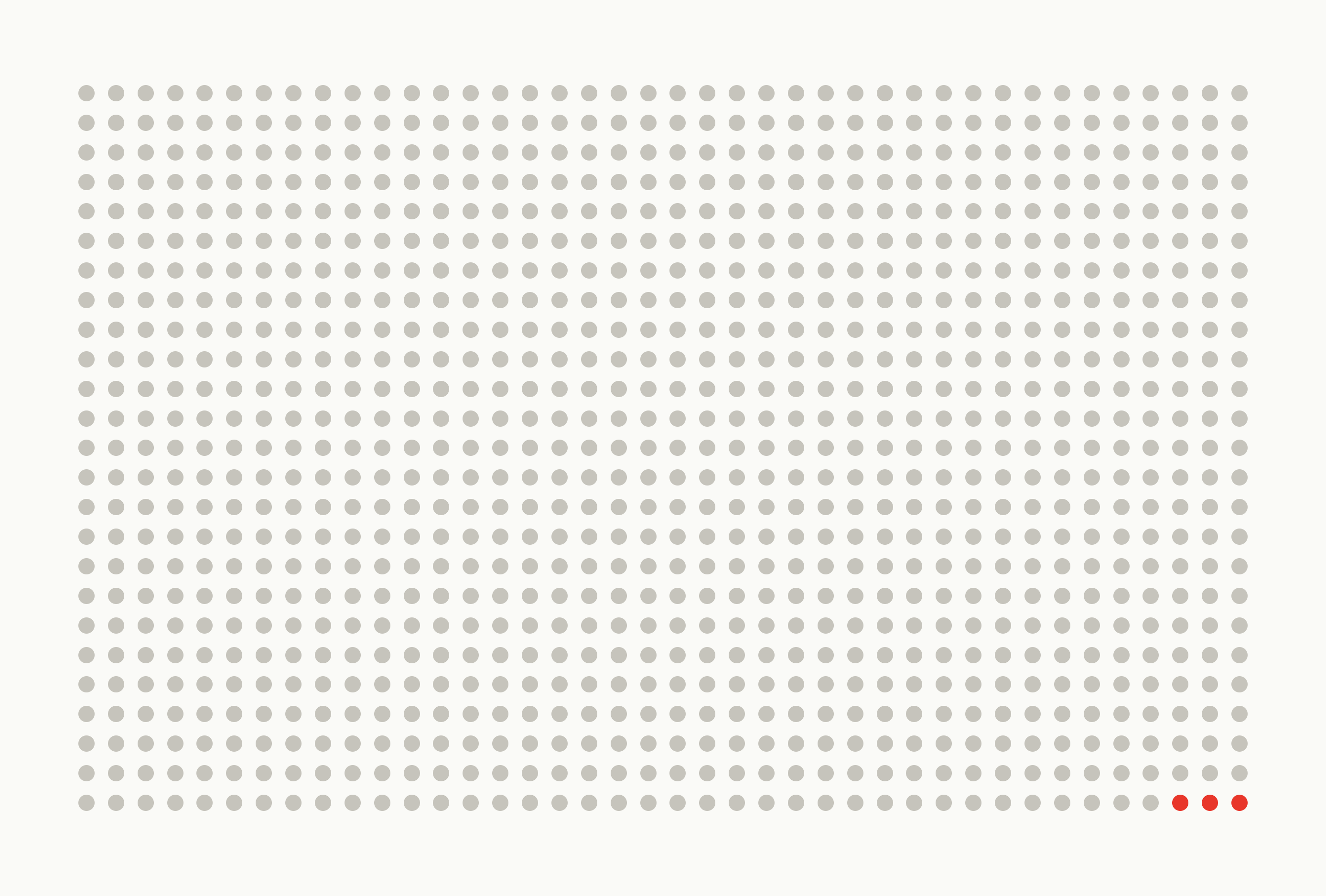
Mail front. 1,000 homes. Fewer than 3 sell to Opendoor.
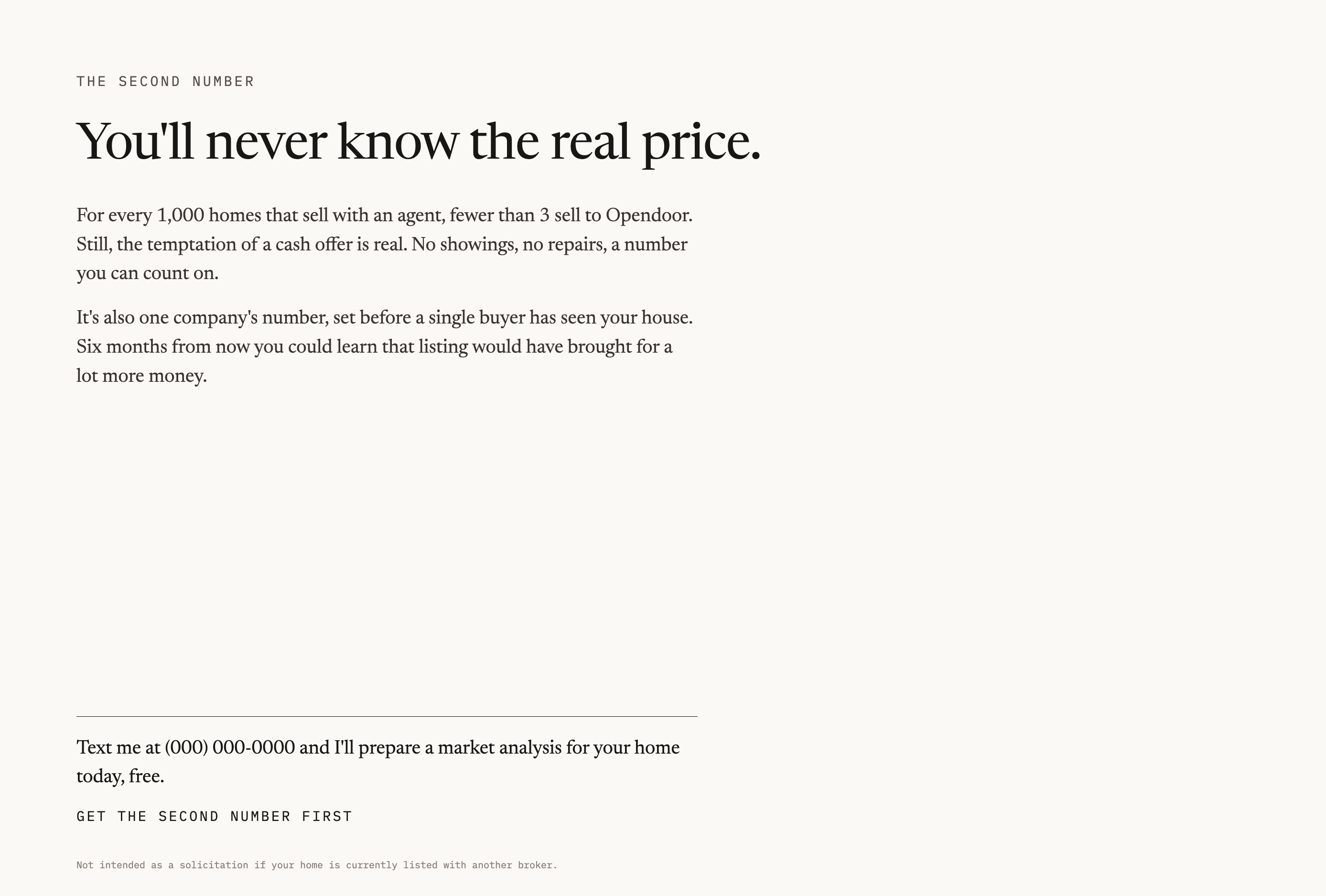
Mail back. Concede the speed, then price it.
These four pieces are direct mail versions of the frame. Every piece concedes the speed, names the number the seller cannot see, and ends on the same line: get the second number first. The front withholds the number and the back does the arithmetic, which is why each concept mails as a front-and-back pair rather than a single card. For list selection, cadence and format, pair the frame with 4 direct mail strategies to win listings and these 5 surprising direct mail concepts.
Free: the feature negative framing setup
The framing structure and the cost calculation are not a download: they are the four steps above. Build the figure in a spreadsheet, service fee plus the spread between the cash offer and likely market price, and bring it to your next listing appointment.
[ your artifact link goes here ]
Run the calculator on your next cash offer lead before the appointment. Take the rest apart and rebuild it in your own voice.
methodology and scope
NAR's 91% agent-assisted figure comes from a survey of owner-occupants who sold a primary residence between July 2024 and June 2025. It is a survey, not a count of all 4.06 million sales. The 3.69 million estimate comes from applying that share to the full-year total.
All advertising figures are the advertising line from Opendoor's 10-K footnotes. They are not the "sales, marketing and operations" line, which was $1.006 billion in 2022 and $310 million in 2025 and consists mostly of holding costs, property taxes, utilities, resale commissions and headcount. Anyone citing SM&O as ad spend overstates Opendoor's advertising by roughly an order of magnitude.
The 450:1 ratio describes 2025. Opendoor's Q2 2026 pace is materially higher, at 4,378 purchases in a single quarter, so the current run rate is well above the 8,241 full-year 2025 figure. The ratio describes last year, not this one, and the trend is worth watching.
Opendoor's Q2 2026 operating metrics are as reported by the company in its Q2 2026 release and August 4 2026 earnings call. Company-reported contribution margin and cost-per-close figures are management measures, not audited GAAP line items.