Keywords for Real Estate Listings: 2026 SEO Guide
Learn the best keywords for real estate listings, where to place them, and how to write keyword-rich descriptions that still sound human.
Learn the best keywords for real estate listings, where to place them, and how to write keyword-rich descriptions that still sound human.
Keywords for Real Estate Listings: What Buyers Actually Search For
You can have perfect listing photos. Drone shots. Twilight. The whole thing. But if the words in your listing don’t match how buyers search, the listing gets buried behind homes that are easier to understand.
Most buyers aren’t reading like a novelist. They’re scanning like a shopper. They type what they want. They filter fast. Then they click the homes that look like a match in two seconds.
That’s what keywords do for a listing. They make the match obvious.
The mistake agents make is thinking “keywords” means stuffing a description with buzzwords. It doesn’t. It means using the same plain language buyers use when they’re looking for a home like yours.
The only keyword rule that matters
If you want the simple rule, it’s this: use the words a buyer would type before they’ve seen your home.
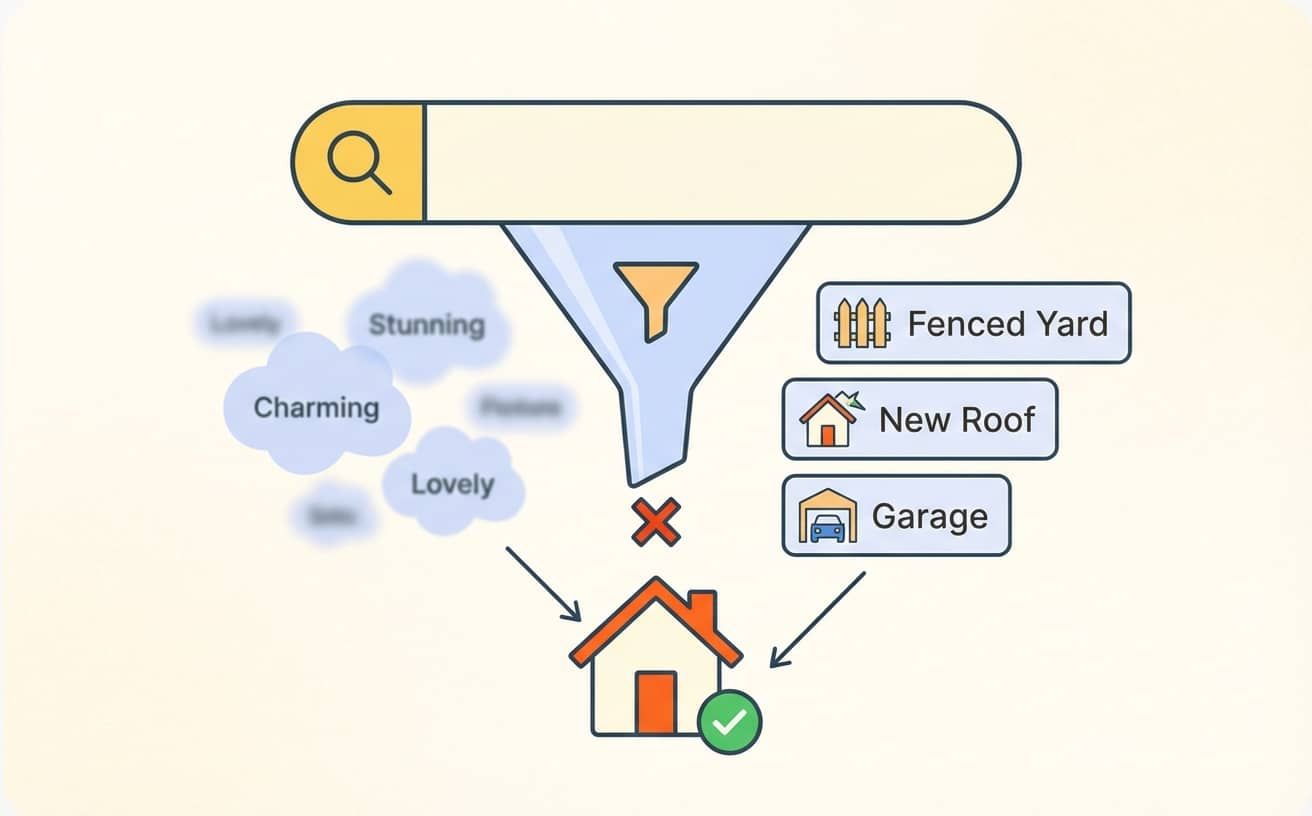
Nobody searches “stunning.”
They search “fenced yard,” “new roof,” “home office,” “walkable to downtown,” “3 bed 2 bath,” “garage parking,” “no HOA,” “waterfront,” “pool.”
You still need good writing. Emotion sells showings. But keywords earn the click.
The three kinds of keywords buyers use
Buyers search in layers.
They start broad. “Homes for sale in [City].” That’s top-of-funnel. You don’t win that game with listing copy. Portals and big sites dominate it.
Then they narrow. “Townhomes in [Neighborhood].” “Condos with garage parking.” “Waterfront homes.” Now you’re in real intent.
Then they get specific. This is where the money is. “3 bedroom ranch in [Neighborhood] with finished basement.” “Move-in ready home with fenced yard and updated kitchen.” The search volume is smaller. The buyer is hotter. These are the people who book showings.
Your listing description should be written for that last group. Specific. Concrete. Easy to picture.
How to find the best keywords without paying for tools
You don’t need fancy software to write better listing keywords. You need better inputs.
Start with Google autosuggest. Type “[City] homes with…” and watch what it fills in. Same with “[Neighborhood] homes…” Those suggestions are real searches.
Check “People Also Ask” when you search your area. If buyers keep asking the same questions, that language belongs in your marketing ecosystem. Sometimes in the listing. Often in a neighborhood guide or a landing page that supports the listing.
Then do the most underrated move: listen to your buyers. If everyone says “in-law suite,” don’t hide behind “ADU.” Use both once, but lead with the phrase they actually say out loud.
And don’t ignore portal filters. Buyers learn the vocabulary from the filters. If “open floor plan” is what they click, that’s the phrase to use. Not “flowing entertaining space.”
The keyword buckets that cover most listings
If you write a listing and you’re not sure what to include, think in five buckets. Most great descriptions hit all five without trying too hard.
- Location: neighborhood name, city, nearby landmark, commute cue.
- Property basics: single-family, condo, townhome, ranch, colonial, etc.
- Layout: bed/bath, main-level living, finished basement, bonus room.
- Condition: move-in ready, renovated, new roof, new HVAC, updated kitchen.
- Lifestyle features: fenced yard, patio, pool, garage, views, waterfront, no HOA.
That’s it. If you cover those naturally, you’ll already be ahead of 80% of listings.
A practical keyword cheat sheet (use what’s true)
You don’t need to paste lists into the MLS. You use these as reminders while you write.
Interior keywords that usually matter: updated kitchen, quartz countertops, granite countertops, stainless steel appliances, hardwood floors, open floor plan, finished basement, home office, primary suite, walk-in closet, mudroom, pantry, high ceilings.
Exterior keywords that usually matter: fenced yard, patio, deck, screened porch, pool, outdoor kitchen, corner lot, cul-de-sac, oversized lot, three-car garage, low-maintenance landscaping.
Location and convenience keywords: minutes to downtown, near parks, near transit, close to [highway], near [major employer], near [hospital], near [university], waterfront, golf course views.
Condition and timing keywords (use carefully): move-in ready, renovated, new roof, new HVAC, recently updated, vacant, immediate possession (only if accurate and allowed).
One quick note: avoid MLS trouble by keeping claims factual. “Priced to sell” and “motivated seller” can be frowned on in some systems. Even when allowed, they’re vague. A buyer trusts specifics more than slogans.
Where to put keywords so they actually help
You don’t scatter keywords everywhere. You place them where buyers and platforms look first.
Start with your headline. “Welcome Home!” is friendly. It’s also useless. Lead with the facts that matter:
“Updated 3-bed ranch in [Neighborhood] with fenced yard + finished basement.”
Then focus on the first two sentences of the description. That’s the mobile preview. That’s what gets skimmed.
If the home has one truly special feature, mention it early. New roof. Views. Oversized lot. Garage parking. Don’t bury the best hook in paragraph three.
After that, write like a human. Walk them through the home in the same order they’d experience it. Living area. Kitchen. Primary suite. Outdoor space. Then a clean close.
The easiest way to write “keyword-rich” without sounding robotic
Here’s a simple pattern that keeps copy natural.
Open with: **type + location + layout + top two features.
**Then expand with short sentences that explain what those features feel like.
Example opening that works:
“Move-in ready 3-bedroom, 2-bath home in [Neighborhood] with an open floor plan, updated kitchen, and fenced yard.”
Now you’ve covered the buyer’s filters. From there you can write normally.
If you want to include a few feature bullets, do it once, and keep it tight. Bullets are best when they summarize upgrades buyers care about, not when they read like a hardware store receipt.
“Fluff” words that hurt more than they help
A lot of listings read like this: beautiful, charming, stunning, must-see, won’t last. Buyers skim right past it because it doesn’t tell them anything.
A better habit is swapping fluff for proof:
- “Charming” → “original hardwoods + updated kitchen”
- “Stunning views” → “mountain views from the back deck”
- “Cozy” → “efficient layout + great natural light”
- “Entertainer’s dream” → “open kitchen + large island + patio”
You still get emotion. You just earn it with specifics.
Fair Housing and keyword choices
Keep your language focused on the home and objective location benefits. Avoid phrases that imply who should live there. That includes lines like “perfect for families,” “great for young professionals,” or “safe neighborhood.”
Describe the property. Describe the features. Describe proximity in neutral terms. If you do that, you stay on the right side of both compliance and good taste.
FAQ
What are the best keywords for real estate listings?
The best keywords are the ones buyers actually type and filter by: location (neighborhood/city), property type, bed/bath and layout terms, condition words (updated, renovated, new roof), and lifestyle features (fenced yard, garage, pool, views). If you cover those in plain language—especially early in the description—you’ll match more high-intent searches without making the copy feel stuffed.
Where should keywords go in a listing description?
Put the most important keywords in the headline and the first two sentences because that’s what buyers see in previews and on mobile. After that, weave keywords in naturally as you describe each area of the home. Think of it as “mention it where it belongs.” Kitchen upgrades in the kitchen paragraph. Outdoor features in the outdoor paragraph. Repeating keywords unnaturally doesn’t help and can make the listing feel spammy.
How many keywords should I use in one listing?
Don’t count keywords. Count clarity. A strong listing usually includes 8–15 “real” keyword phrases naturally (location, type, layout, a few upgrades, and a few lifestyle features). If your description starts reading like a checklist, you’ve gone too far. The best listings feel human first and just happen to include the buyer’s vocabulary.
What keywords work best for luxury listings?
Luxury buyers still care about basics, but they respond to specificity. “Chef’s kitchen” means nothing unless you name what makes it premium: 36” range, vent hood, high-end appliances, custom cabinetry, walk-in pantry, quartz or stone, etc. Same for “spa-like bath” or “resort-style yard.” The keyword strategy is the same—use buyer language—but the details need to justify the words.
Should I include school-related keywords in listing copy?
You can reference school districts or zoned schools factually if you’re accurate and consistent with local rules, but avoid language that implies a preferred type of buyer. Stick to neutral phrasing (“zoned for [School Name]—buyer to verify”) rather than value judgments or demographic cues. When in doubt, keep it factual and let the buyer decide what matters to them.
Do keywords matter on Zillow and other portals, or only on Google?
They matter everywhere buyers search. Portals rely heavily on structured data and filters, but the headline and description still influence how quickly a buyer understands the home and whether they click. Google is more text-sensitive, especially if the listing is on your website or syndicates to a page that Google can index. The safest move is simple: write clearly, front-load the key facts, and use the same words buyers use.
Can I use AI to write listing descriptions with good keywords?
Yes, but treat AI as a draft tool, not a fact tool. Feed it verified features and constraints, then edit the output line by line to remove anything inaccurate, exaggerated, or risky. AI is great at structure and vocabulary. You’re responsible for truth, compliance, and local nuance. The best workflow is: generate → verify → humanize.