Just Sold Real Estate Postcards: 2026 Marketing Guide
Learn how to use just sold real estate postcards to generate seller leads with better design, smarter targeting, and follow-up that actually gets replies.
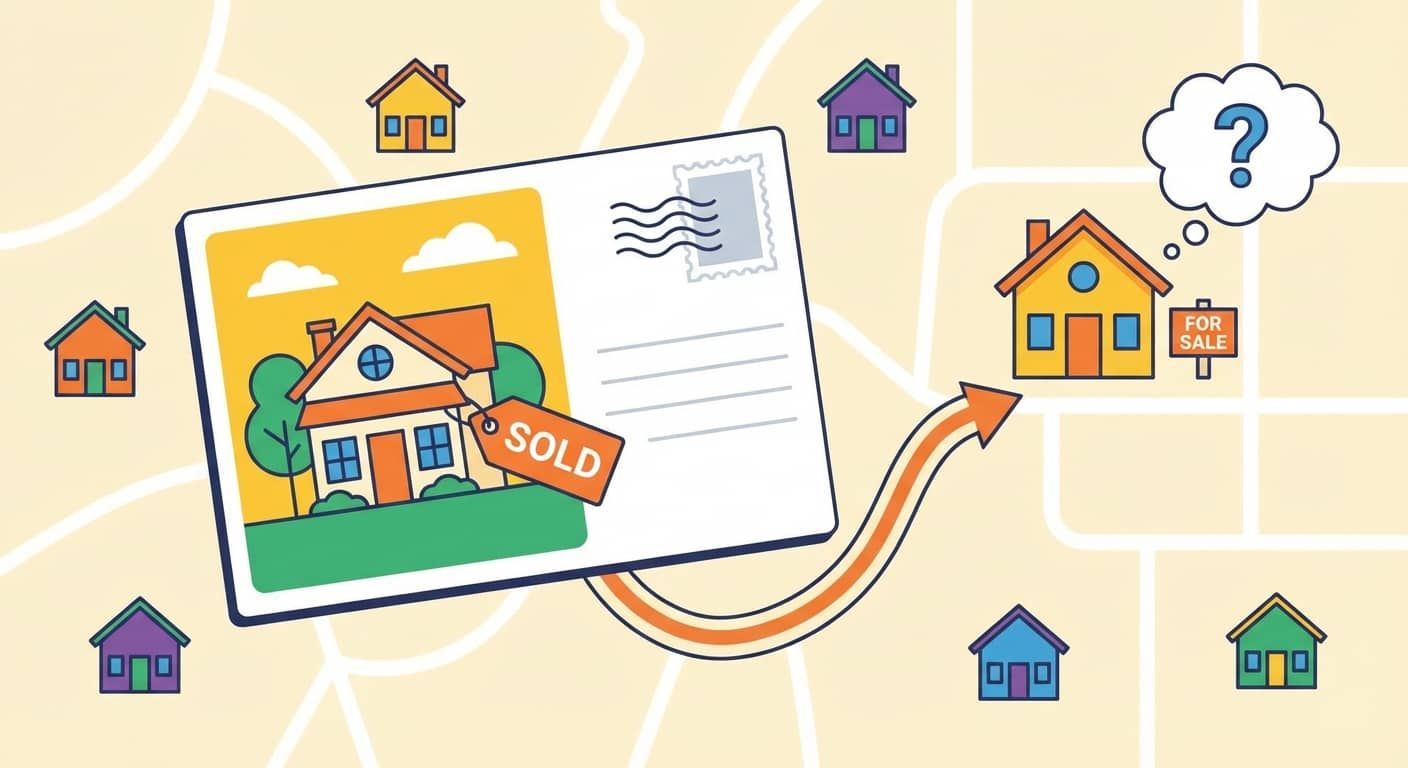
Learn how to use just sold real estate postcards to generate seller leads with better design, smarter targeting, and follow-up that actually gets replies.
Just Sold Real Estate Postcards That Turn One Closing Into the Next Listing
You close a deal. The sign comes down. The neighbors notice.
If you do nothing, that moment fades. The neighborhood moves on. The next agent’s sign goes up and the story becomes theirs.
A just sold real estate postcard is how you keep the momentum. Not by bragging. By making the sale feel local and real, and by giving the closest homeowners a simple next step if they’re curious.
The mistake agents make is treating these cards like “branding.” They’re not. They’re a short, neighborhood-specific trigger that makes homeowners ask the question you want them asking:
“If that home sold… what would mine sell for?”
That question is your lead.
Why postcards still work when everything is digital
Email gets deleted. Ads get scrolled past. A postcard shows up in the middle of bills and flyers and still has a chance to be noticed, mainly because it’s tied to something the homeowner already saw in real life. They drove past the sign. They saw the showing traffic. They heard a neighbor mention it.
The card is simply the follow-up to that street-level awareness.
It works best when it feels like a quick market update, not a pitch. The tone matters. “Here’s what happened nearby” lands better than “Look how great I am.”
What a “Just Sold” card is really doing
The card isn’t trying to convince someone to sell today. It’s doing three quieter things.
It proves you can close in their area. It creates curiosity about value. Then it gives them a low-pressure way to get an answer.
That’s why “Just Sold” tends to be stronger for seller leads than “Just Listed.” A listing is a promise. A closing is proof.
Design that gets read instead of tossed
Most postcard designs fail because they try to say everything. Sellers don’t read mail like a brochure. They glance. They decide.
The front should have one clear job: get recognized in two seconds.
A clean front usually includes a strong exterior photo, a simple “JUST SOLD,” and one proof point. Not five. One. Sold in X days. Multiple offers. Sale price if it’s allowed and appropriate. If you add too many stats, the card starts feeling like a flyer and the eye moves on.
Your headshot matters, but it shouldn’t be the focal point. The hero is the house and the result. Put your face on the back with clear contact info so they can connect the proof to a person.
Size helps. A larger card is harder to ignore, but a standard size still works if it’s clean. White space is not wasted space. It’s what makes the message readable.
If you want one practical upgrade that pays off, use a glossy front for the photo and a writable back. That way you can add a quick handwritten note to the closest homes when it makes sense.
Copy that gets replies without sounding like a salesperson
The most common CTA on postcards is also the weakest: “Call me for more information.”
Nobody wants more information. They want an answer.
Your copy should lead to one simple offer. A one-page neighborhood sales report. A quick value range. A street-level comp snapshot. Something small enough to feel safe, but valuable enough to respond to.
Headlines don’t need to be clever. They need to be specific.
“JUST SOLD in [Neighborhood]” works.
“Another home sold near you” works.
“Curious what your home could sell for right now?” works.
Then you keep the body short. A couple lines is enough. What happened, why it matters, and how to get the update.
This is also where agents hurt themselves by trying to sound impressive. Skip the hype. Don’t overclaim. Don’t say “record price” unless it truly is. Don’t promise “top dollar.” If the card feels inflated, the homeowner assumes the same about your pricing advice.
Price on the card: sometimes yes, sometimes no
Including the sale price can work, but it isn’t always the best move. Some sellers don’t want it broadcast. Some MLS rules and local norms discourage it. And sometimes the price isn’t the most persuasive proof point anyway.
If you can’t use price, use a clean alternative. Sold in 9 days. Multiple offers. Strong demand in the neighborhood.
The goal is not the number. The goal is the homeowner thinking, “This affects me.”
Targeting: who should actually get the card
If you mail randomly, you’ll get random results.
The smartest “Just Sold” targeting is simple: start with the closest homes first. Those owners care most because the comp is now part of the conversation about their value. They recognize the house. They’ve been watching it. They want to know what it did.
A tight radius around the sale is usually your highest-leverage list. From there you decide whether you’re running a one-off campaign or building a farm.
If you want broad coverage and simple execution, EDDM can work well. You pick a route and blanket it. It’s not precise, but it’s consistent and easy.
If you want fewer wasted pieces, a targeted list can be better, especially if you’re filtering out obvious renters or recent buyers. The tradeoff is list quality varies, and you’re paying for that “precision.”
For most agents, the winning formula is boring: mail the closest homes, track responses, and repeat. Expansion only helps if consistency is already there.
Timing: don’t wait until the neighborhood forgets
These cards work best when the sale still feels fresh.
Aim for the postcard to land within about a week of closing. If you wait a month, you’re mailing history. Not news. You can still mail, but the message should shift into a “recent neighborhood sales update” instead of “just sold.”
And one card is rarely enough. You don’t need to hammer people, but you do need to show up more than once if you want long-term payoff. The follow-up piece a few weeks later—something like a short market update—helps turn “I’ve seen that name before” into familiarity.
Tracking: make it measurable without making it complicated
Print feels untrackable when you don’t build tracking into the offer.
A QR code that goes to a simple page works. A text keyword works. A unique short URL works. The point is to separate postcard responses from everything else you do.
Once you can attribute responses, you can improve the campaign instead of guessing.
Don’t overcomplicate the metrics. Track what matters: scans/texts, form submissions, conversations, appointments, listings.
A lot of postcard ROI shows up later. Someone gets the card, thinks about it, and texts you two months later after one more life event nudges them. That’s normal. Tracking helps you connect the dots.
Follow-up: where most agents waste the lead
The postcard doesn’t create the listing. Your follow-up does.
When someone scans the QR code or requests the report, respond fast. Same day. Not with a sales pitch. With delivery.
“Thanks for requesting the neighborhood report. Do you want it by text or email?”
Then send it. Keep it simple. If they engage, ask one qualifier:
“Are you just curious, or are you thinking about selling this year?”
That question tells you how to follow up without guessing. It also keeps the conversation calm. Homeowners don’t mind being asked. They mind being pressured.
Compliance: keep it clean
Before you print, make sure your brokerage branding meets your local rules. Keep your claims factual. If you’re using stats like “sold in 3 days,” make sure they’re backed up. If you co-listed, don’t present it like you were the only agent unless you’re allowed to.
Be careful with language that describes the buyer. Avoid “perfect for families” and similar phrases. Keep your copy focused on the property and objective location benefits.
FAQ
How many just sold real estate postcards should I send?
Start with the nearest homes to the sale, not the entire ZIP code. Those owners are most likely to recognize the property and care about the result because it impacts their perceived value. A practical starting range is 100–250 homes around the sold property. If you’re farming long-term, you can expand to the full neighborhood, but only if you’re willing to mail consistently. One big drop without repetition usually turns into a “nice card” and nothing more.
When should I mail a just sold postcard?
Mail fast while the sale still feels current. The goal is to land within about a week of closing, while neighbors are still aware the home was for sale and curiosity is high. If you wait too long, you can still mail, but the angle should change to a “recent neighborhood sales update” rather than a “just sold” announcement. The closer your timing is to the sale, the more the postcard feels like relevant local news instead of random advertising.
Should I include the sold price on the postcard?
Sometimes yes, sometimes no. Sold price can create instant curiosity, but it’s not always allowed, appropriate, or necessary. Some sellers don’t want their price promoted. Some MLS rules and local norms discourage it. In those cases, use a different proof point that still signals demand: sold in X days, multiple offers, or strong buyer interest in the neighborhood. The purpose isn’t the number itself; it’s to make homeowners wonder what their home would sell for right now.
What’s the best design for a just sold real estate postcard?
The best postcards are simple enough to understand in two seconds. One strong exterior photo, a clear “JUST SOLD,” and one proof point work better than crowded layouts filled with stats and logos. Your headshot and contact info belong on the back, not as the hero image. White space matters because it makes the card scannable. Bigger sizes can get noticed more, but a standard size still performs if the design is clean and the offer is strong.
What call to action gets the best response?
The CTA should be one step and value-first. “Call for information” is vague and easy to ignore. A better CTA offers something specific and small: a one-page neighborhood sales report, a quick home value range, or a street-level comp snapshot. Pair it with an easy action like “scan” or “text VALUE.” When the homeowner knows exactly what they’ll get and it feels low-pressure, response goes up.
How do I track postcard results without guessing?
Use a QR code that goes to a dedicated landing page, a text keyword, or a unique short URL so postcard responses are separate from your other traffic. Then track a few simple metrics: scans/texts, form submissions, conversations, appointments, and listings won. Don’t judge success only in the first 48 hours. Postcards often produce delayed ROI because homeowners act when their timeline changes. Tracking helps you tie that later lead back to the campaign.
What should I do when someone scans the QR code or requests the report?
Respond the same day and focus on delivery, not persuasion. A short message like “Do you want the report by text or email?” keeps it easy. Send the report quickly, then ask one simple qualifier to guide next steps: “Are you just curious, or are you thinking about selling this year?” If they’re a long-term lead, put them into a light monthly update. If they’re closer to selling, offer a quick call to walk through the numbers and timing.
Are just sold postcards better than just listed postcards?
They serve different purposes. Just listed postcards can help find a buyer and drive open house traffic. Just sold postcards are typically stronger for seller leads because they prove you can actually close. A listing is a promise. A closing is proof. If your main goal is more listings, “just sold” tends to build trust faster, especially when it’s mailed to the closest homes and paired with a clear offer like a neighborhood sales report.