
Why Direct Mail Still Dominates in a Digital World
While agents chase expensive Facebook leads and burn through Zillow budgets, the most profitable prospecting channel sits right under their noses: the mailbox. Direct mail generates higher response rates than email, costs less than digital advertising, and reaches homeowners exactly where they make their biggest financial decisions — at home.
The numbers don't lie. Direct mail response rates average 4.9% compared to email's 0.6%. When a homeowner holds a physical letter, they process it differently than a digital message. There's weight. There's intention. There's a human being on the other end who spent money to reach them specifically.
But here's what separates the agents who win from those who waste money: strategy beats volume every time.
Why Most Agents Fail at Direct Mail
Most agents approach direct mail like throwing spaghetti at a wall. They buy a list of 5,000 names, send the same generic postcard to everyone, and wonder why their phone doesn't ring. The problem isn't the channel — it's the execution.
The fatal mistakes: wrong message, wrong audience, wrong follow-up. Agents send "Just Sold" postcards that scream "Look at me" instead of "I can help you." They mail to everyone instead of the specific homeowner most likely to respond. They send one piece and give up instead of building a systematic follow-up sequence.
The biggest mistake of all: they don't have a real reason to contact the homeowner. Generic prospecting feels like spam because it is spam. The homeowner can sense the difference between authentic outreach and mass marketing from the first sentence.
The Magic Buyer Letter Strategy
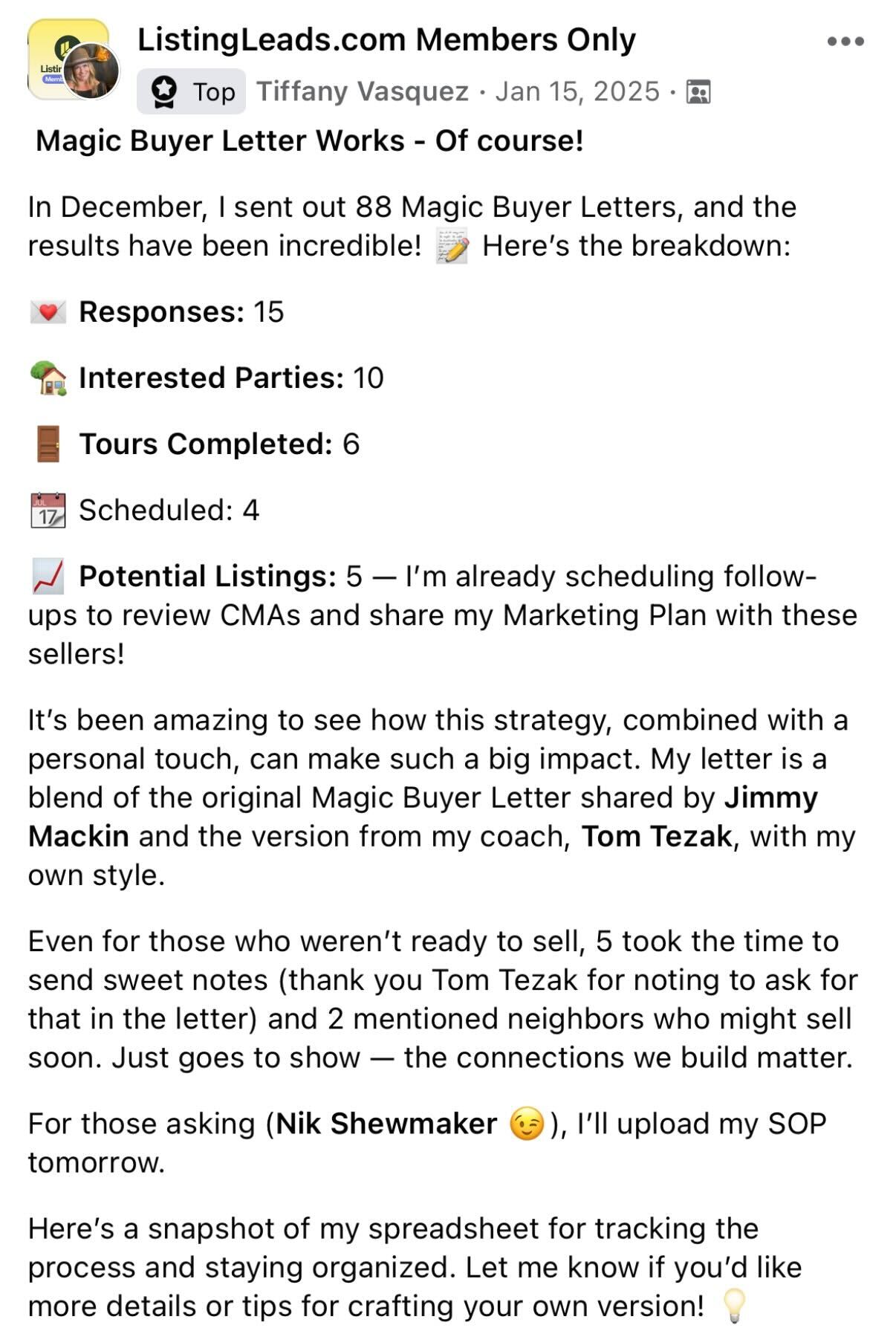
The campaign that changed everything for Tiffany Vasquez wasn't complicated — it was strategic. Instead of broadcasting to thousands, she targeted exactly 118 homeowners with a specific message: she had a real buyer looking for a home exactly like theirs.
The Magic Buyer Letter works because it flips the traditional prospecting script. Instead of "Are you thinking of selling?" it asks "Would you consider selling to the right buyer?" The psychology is completely different. One feels like pressure. The other feels like opportunity.
Here's the strategic logic: Every letter was sent only to homeowners whose properties matched her buyer's exact criteria. Location, price range, home style, lot size — everything aligned. The targeting was so precise that some mailings included only 20 homes. Quality over quantity.
The letter itself followed a simple formula: "I have a buyer looking for a home exactly like yours. If you've ever considered selling, I'd love to show them your property. Even if you're not ready now, I'd appreciate knowing so I can update my client."
Why This Campaign Generated 18.6% Response Rates
The 22 responses from 118 letters represent more than just good numbers — they reveal the psychology of effective prospecting. Three frameworks explain why this approach worked when generic mail fails.
Cialdini's principle of reciprocity explains the opening move. By leading with "I have a buyer" instead of "I want your listing," Tiffany gave value first. The homeowner immediately understood: this agent has something I might want (a qualified buyer) rather than wanting something from me (a listing).
Robert Bly's motivating sequence is embedded in the letter structure. It gets attention ("buyer looking for your home"), identifies the opportunity ("exactly like yours"), positions the solution ("I'd love to show them"), and makes the smallest possible ask ("let me know either way").
Most powerfully, Jeremy Miner's NEPQ principle — letting prospects persuade themselves — drives the entire approach. The letter doesn't pitch. It asks. "Would you consider selling to the right buyer?" invites the homeowner to evaluate their own situation rather than resist a sales message.
The targeting amplified everything. When a homeowner receives a letter about a buyer wanting "a 3-bedroom ranch in Bend with mountain views" and they live in exactly that house, the relevance creates instant credibility. The message feels personal because it is personal.
The $282,750 Result
Tiffany Vasquez, a 20-year veteran with 47 five-star reviews and hundreds of transactions, knows what works. But even she was surprised by the immediate impact of her 118 Magic Buyer Letters.
The numbers tell the story: $161 invested generated $58,750 in closed commission from 2 immediate sales. But that's just the beginning. The campaign also produced 6 additional listings worth $9 million in potential sales volume, representing $224,000 in future commission.
"I got your letter about a buyer and I'm just calling you back," became the most profitable phone call of her month. The response rate wasn't just high — it was targeted. 22 responses meant 22 qualified conversations with homeowners who had exactly what her buyer wanted.
Tiffany's systematic approach extended beyond the initial mailing. She maintained a detailed spreadsheet tracking every response, walked through most of the homes personally, and stayed in regular contact with interested homeowners who weren't ready to move immediately. The result: a 36,500% return on investment in 30 days, with a pipeline worth nearly $300,000 in total commission.
"I'd rather go high quality over quantity," Tiffany explains. "If you only have a certain budget, you better fine-tune who you're reaching out to."
Start Your First Magic Buyer Letter Campaign
The Magic Buyer Letter isn't just a template — it's a systematic approach to turning real buyer needs into listing opportunities. When you have a qualified buyer, you have the perfect reason to contact homeowners who own exactly what that buyer wants.
The campaign Tiffany used is available inside ListingLeads, complete with targeting guidelines, letter templates, and follow-up sequences. Your first conversation could happen this week.
The Results
“I'd rather go high quality over quantity. If you only have a certain budget, you better fine-tune who you're reaching out to.”